Replacement parts, overhaul and specialized technical assistance for decanter centrifuges, built to the standards of the industry's leading manufacturers.
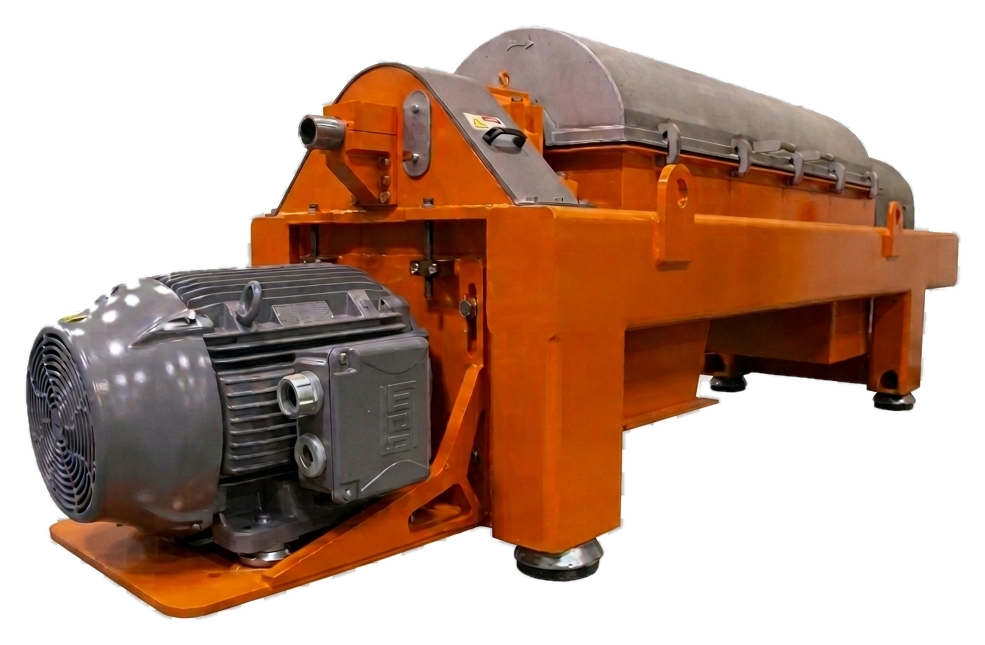
The centrifugal decanter is a continuous separation machine designed to treat mixtures with high solids content — well above what a conventional disc separator can handle. It's the right machine when the process doesn't just involve “polishing” a liquid, but rather dewatering, thickening or extracting large volumes of solid from a mixture.
Its operating principle differs from that of the disc separator: instead of a stack of conical discs, the decanter has an elongated cylindrical-conical bowl, inside which a coaxial scroll (auger) rotates at a slightly different speed than the bowl. This speed difference between the bowl and the scroll is what continuously drags the solid settled on the bowl wall toward the conical end, where it's discharged — while the clarified liquid moves toward the opposite end and is discharged through weirs or a centripetal pump (impeller) system.
The centrifugal force generated can exceed 3,000 times the force of gravity, reducing sedimentation processes that would take hours down to a few seconds — with solid and liquid discharge happening simultaneously and continuously, with no need to stop the machine.
The main classification of decanters isn't based on the solid discharge mechanism (which is always via the scroll), but rather on how many phases the equipment is able to separate.
Choosing the right model depends on how many valuable liquid phases exist in the process.
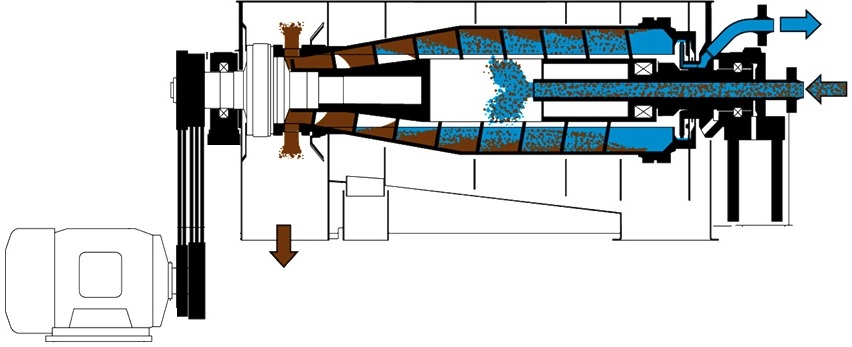
The 2-phase model separates the mixture into just two outputs: a solid phase (the cake, already partially dewatered) and a single liquid phase (the clarified liquid).
The solid settles on the bowl wall through centrifugal action and is conveyed by the scroll to the conical outlet, discharged with as little moisture as possible. The liquid, free of solids, is discharged through the opposite cylindrical end, usually through adjustable weirs that control the depth of the liquid layer inside the bowl.
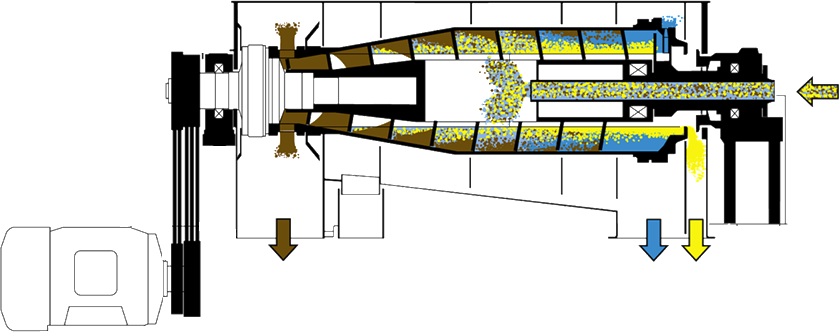
Also called a tricanter, this model goes beyond solid-liquid separation: it simultaneously separates the solid and two liquid phases of different densities — for example, oil and water — into three distinct outputs.
Internally, the tricanter has a disc or baffle system that directs the two liquid phases to independent outlets, avoiding cross-contamination between them. Since the ratio between the heavy and light phases can vary during the process, the equipment has an adjustment disc (paring disc) — manually adjustable or, in more modern models, via a centripetal pump with automated control — that correctly positions the interface between the two liquid phases, ensuring maximum purity at each outlet.
The decision between a 2-phase or 3-phase decanter depends directly on the process composition: whether there's only one liquid phase to recover, or two liquid phases of different densities with value to extract. A technical diagnosis of the feed mixture — solids content, densities involved and process objective — is what defines the right machine (or overhaul) for each application.
